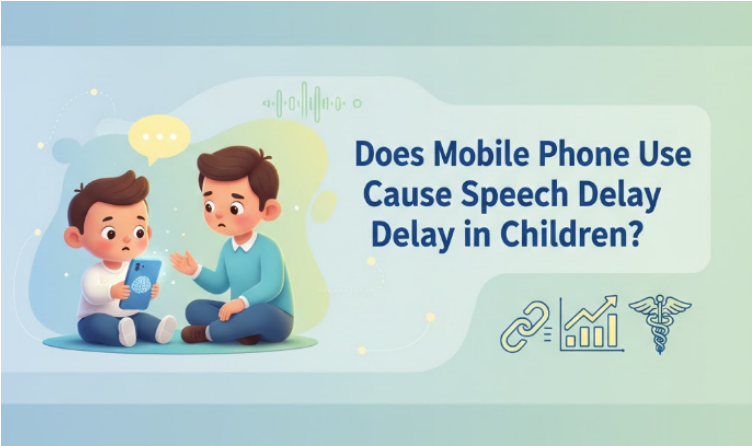
Can mobile phones cause speech delay in children?
Yes, excessive and unsupervised mobile phone use can increase the risk of speech and language delays in children, particularly those under age 5. Research shows that screens don’t directly cause delays, but they replace critical face-to-face interactions that build language skills. Children need real-time conversation, not passive screen watching, to develop speech normally.
What Is Speech Delay in Children?
Speech delay occurs when a child doesn’t develop language skills at the expected rate for their age. According to the American Speech-Language-Hearing Association (ASHA), typical warning signs include:
Age 12 months:
- Not using gestures like pointing or waving
- Not saying “mama” or “dada”
Age 18 months:
- Saying fewer than 10 words
- Not pointing to show things to others
Age 2 years:
- Using fewer than 50 words
- Not combining two words (e.g., “more milk”)
Age 3 years:
- Not using simple sentences
- Difficult for strangers to understand
Important: Speech delay doesn’t indicate low intelligence. Many children with delays are cognitively typical and simply need appropriate support and language-rich environments.
How Mobile Phones Affect Speech Development
Mobile devices don’t damage the brain or vocal cords. Instead, they create an opportunity cost — they replace activities essential for language development.
The Science: Why Face-to-Face Interaction Matters
Children’s brains are wired for serve-and-return interactions. Research from Harvard’s Center on the Developing Child shows that back-and-forth exchanges literally build neural pathways for language.
What children need for speech development:
- Joint attention — shared focus on the same object or activity
- Contingent responses — immediate feedback to their sounds
- Prosody and emotion — tone, facial expressions, body language
- Turn-taking practice — conversational rhythm
- Social motivation — desire to communicate with caregivers
What screens provide:
- One-way information flow
- No personalized response
- Fixed content regardless of child’s reaction
- Visual overstimulation without interaction
This mismatch explains why even “educational” content can’t replace human conversation.
Research and Statistics on Screen Time and Speech Delay
Canadian Paediatric Society (2017):
Every 30 minutes of extra screen time raised expressive speech delay risk by 49% (ages 18–36 months)
WHO Guidelines (2019):
Under 2 years: No screen time
Ages 2–4: Max 1 hour/day
Why Under Age 5 Is Critical
The first five years represent a sensitive period for language acquisition:
- Brain plasticity is at its peak
- Neural connections form rapidly (1 million per second)
- Language foundations affect literacy, academic success, and social skills
- Early delays can compound without intervention
How Excessive Phone Use Creates Speech Delay: 4 Mechanisms
1. Reduced Conversational Turns
The Word Gap Research: Children from high-language homes hear 30 million more words by age 3 compared to low-language homes. But quantity alone isn’t enough — conversational turns matter more.
What happens with excessive phone use:
- Fewer questions asked by parents
- Fewer opportunities for children to respond
- Reduced verbal modeling
- Lower overall word exposure
Example: A child watching a 30-minute show might hear 2,000 words but engage in zero conversational exchanges. The same 30 minutes of play with a parent might include 200 words but 50 conversational turns — far more valuable for language development.
2. Passive Consumption vs. Active Learning
Children learn by doing, not just watching. Speech development requires:
- Attempting sounds and words
- Receiving correction and encouragement
- Practicing through repetition
- Adjusting based on feedback
Screens provide none of this active practice loop.
3. Displacement of Language-Rich Activities
When screen time increases, these decrease:
- Reading together (builds vocabulary and narrative skills)
- Pretend play (encourages symbolic thinking and storytelling)
- Songs and rhymes (develop phonological awareness)
- Outdoor exploration (provides topics for conversation)
- Mealtime conversations (teach turn-taking and social language)
4. Parent-Child Interaction Quality
“Technoference” — when devices interrupt parent-child interactions — is increasingly documented:
- Parents on phones miss communication cues
- Children make fewer bids for attention
- Quality of interaction decreases even when physically present
- Emotional attunement suffers
A 2021 study found that parental phone use during play sessions correlated with children’s lower language scores, independent of children’s own screen time.
Age-Specific Screen Time Recommendations
Birth to 18 Months: No Screens (Except Video Calls)
Why: This is the most critical period for foundational language development.
What to do instead:
- Talk constantly during routines (diaper changes, meals, baths)
- Read board books daily
- Sing songs and nursery rhymes
- Play peekaboo and other interactive games
- Narrate your activities (“I’m washing the red apple”)
Exception: Video calling with grandparents or distant family members counts as social interaction, not screen time.
18-24 Months: Minimal, Co-Viewing Only
Recommendation: Avoid screens when possible; if used, keep to 15-20 minutes with active parent participation.
Best practices:
- Watch together and talk about what you see
- Pause to ask questions
- Connect screen content to real life (“Like your teddy bear!”)
- Choose slow-paced, educational content
Ages 2-5: Maximum 1 Hour Daily
Guidelines:
- High-quality, age-appropriate content only
- Co-view whenever possible
- No screens during meals, 1 hour before bed, or in bedrooms
- Balance with 2-3 hours of active play daily
Quality content characteristics:
- Slow pacing with pauses
- Encourages participation (e.g., “Can you find the blue one?”)
- Teaches prosocial behaviors
- Age-appropriate themes
Examples of quality programs:
- Sesame Street
- Daniel Tiger’s Neighborhood
- Bluey
Ages 5+: Consistent Limits with Media Plan
Create a family media plan that includes:
- Designated screen-free times and zones
- Balance between active and passive entertainment
- Media literacy discussions
- Monitoring of content and duration
Warning Signs Your Child May Have Excessive Screen Exposure
A child may show behavioral red flags by consistently preferring screens over interacting with people, having tantrums when screens are taken away, making limited eye contact, not responding when their name is called, or showing little interest in toys or books.
Communication concerns can appear when a child uses fewer words than expected for their age, rarely attempts to imitate sounds or words, shows limited facial expressions, does not show interest, or seldom initiates communication with others.
Social warning signs may include playing alone even when other children or adults are present, avoiding pretend or imaginative play, showing minimal emotional response to caregivers, and having difficulty transitioning between activities.
Screen use may become problematic if a child consistently chooses screens over play or social interaction, regularly exceeds recommended screen-time limits, shows regression in language skills, throws frequent tantrums when screens are restricted, or relies on screens as the primary way to calm down or stay occupied.
If several of these signs are present, it’s important to reassess screen habits and consult a pediatrician for guidance and early support.
What Parents Can Do: Evidence-Based Action Steps
Creating a Language-Rich Environment (No Guilt Required)
Daily Habits That Build Language
- Narrate Your World (Self-Talk) Describe what you’re doing as you do it:
- “I’m putting the blue cup on the table”
- “Let’s wash your hands with warm water”
- “I hear a bird singing outside!”
- Parallel Talk Describe what your child is doing:
- “You’re stacking the red block on top”
- “You found your teddy bear!”
- “You’re looking at the picture book”
- Expand and Extend Build on your child’s communication:
- Child: “Car!”
- Parent: “Yes, that’s a big red car! The car goes vroom!”
- Ask Open-Ended Questions Instead of yes/no questions, try:
- “What do you think will happen next?”
- “Which toy do you want to play with?”
- “How did that make you feel?”
- Read Daily, Even for 10 Minutes
- Choose interactive books with flaps, textures, or sounds
- Point to pictures and name objects
- Ask questions about the story
- Relate books to real-life experiences
- Sing Songs and Recite Rhymes
- Repetition builds memory and language patterns
- Actions songs add movement and engagement
- Traditional nursery rhymes teach phonics
- Engage in Pretend Play
- Play house, store, or tea party
- Use stuffed animals for conversations
- Act out familiar stories
- Encourage storytelling
What If You’ve Already Been Using Screens Heavily?
Don’t panic. Children are remarkably resilient.
Steps to course-correct:
- Gradually reduce screen time (cold turkey often backfires)
- Replace with high-interest alternatives
- Increase interactive play and conversation
- Be consistent with new limits
- Expect resistance initially (it gets better)
- Seek evaluation if you notice persistent delays
Most children show improvement within weeks of increased language exposure and reduced passive screen time.
When to Seek Professional Help
Red Flag Milestones
Consult a pediatrician if your child:
- By 12 months: Does not babble, use gestures, or respond to their name
- By 18 months: Uses fewer than 10 words or does not point to show interest
- By 24 months: Uses fewer than 50 words or does not combine words
- By 36 months: Is difficult for strangers to understand or does not engage in pretend play
- At any age: Loses previously acquired language skills, struggles to follow simple instructions, or shows oral-motor difficulties
Who Can Help
Pediatrician: Conducts developmental screening, rules out medical causes, and provides referrals.
Speech-Language Pathologist (SLP): Performs detailed language assessments, creates therapy plans, and coaches parents.
Audiologist: Identifies hearing loss or auditory processing issues and recommends interventions.
Early Intervention Services: Offer free or low-cost, family-centered support for children under three in many regions.
What to Expect from an Evaluation
An evaluation typically includes developmental history, play-based observation, standardized language testing, oral-motor examination, and parent interviews, followed by clear recommendations and follow-up planning.
Remember: Early intervention leads to better outcomes. Speech therapy is supportive, collaborative, and highly effective.
The Bottom Line: Evidence-Based Takeaways
Mobile phones don’t poison children’s brains or directly damage speech organs. Instead, they create a displacement effect — every hour on a screen is an hour not spent in the language-building activities children need.
Key Points to Remember
✓ Children under 2 need virtually zero recreational screen time
✓ Ages 2-5 should have maximum 1 hour daily of quality content
✓ Co-viewing and conversation make screens less harmful
✓ Face-to-face interaction is irreplaceable for language development
✓ Most screen-related delays improve with increased interaction
✓ Early intervention produces the best outcomes
✓ Perfect parenting isn’t required — connection and consistency are
The Real Question Isn’t “Screens or No Screens?”
It’s: “Are we creating enough opportunities for the human connection that builds language?”
When parents stay engaged, present, and intentional about interaction, children thrive — with or without occasional screen exposure.
If you’re concerned about your child’s speech development, trust your instincts and consult your pediatrician. Early support makes all the difference.
FAQs
Yes. Excessive and unsupervised mobile phone use can increase the risk of speech delay in young children by reducing essential face-to-face interaction.
Screen time impacts speech development the most between birth and 5 years, when language skills are forming rapidly.
Experts recommend no screen time under age 2 (except video calls) and no more than 1 hour per day for children aged 2–5.
Yes. Most children improve when screen time is reduced and interactive conversation, reading, and play are increased.
Educational apps cannot replace human interaction. They are only helpful when parents actively co-view and talk with the child.
Parents should consult a pediatrician if speech milestones are missed, language skills regress, or concerns persist beyond expected age limits.