Introduction
Every child on the autism spectrum experiences the world in a unique way. Some find comfort in predictable routines, while others rely on movement or repetition to regulate their emotions. These behaviours are not problems to fix — they are natural responses to how a child processes their environment.
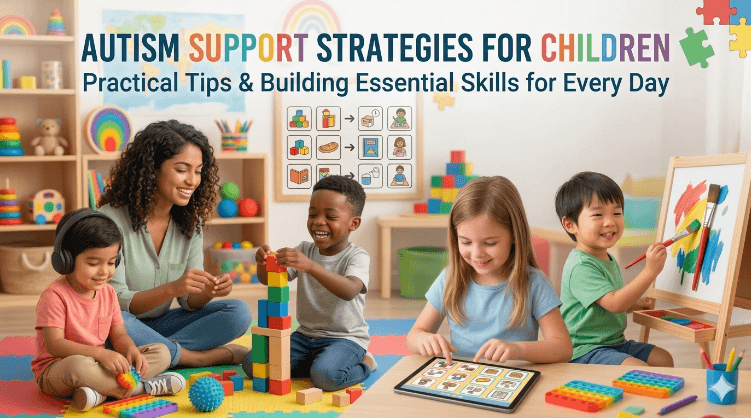
This guide on autism support strategies for children is designed to help parents, caregivers, and educators provide structured, compassionate, and effective support. By focusing on choice, daily routines, preparation skills, and stimming, you can help your child feel more secure, confident, and independent in everyday life.
1. Choice Making:
Building Confidence Through Simple Decisions One of the most effective autism support strategies for children is offering structured choices. When children feel a sense of control, their anxiety reduces and cooperation improves.
However, too many choices can feel overwhelming. The goal is to provide clear, limited options that make decision-making easier.
What You Can Do:
- Offer two choices only
Instead of open-ended questions, give simple options like “apple or banana.” This reduces confusion. - Use visual choice boards
Pictures help children process information faster and make decisions more comfortably. - Always respect their choice
When children see their decisions are valued, they develop trust and confidence. - Define non-negotiables clearly
Some things like safety rules should remain consistent and predictable.
Over time, structured choices help children become more independent and confident in decision-making.
2. Daily Routines: Creating Stability and Reducing Anxiety
Consistent routines are one of the most powerful autism support strategies for children at home. Predictability helps children feel safe and reduces stress caused by uncertainty.
A structured day allows children to focus on learning and interaction instead of worrying about what comes next.
What You Can Do:
- Use visual schedules
Create a daily routine chart with pictures showing each activity. - Prepare for transitions
Give a 5-minute warning before changing activities to reduce resistance. - Keep mornings and bedtime consistent
Stable start and end routines provide emotional security. - Explain changes in advance
If a routine will change, prepare your child early using simple explanations or visuals.
Remember, routines should support your child — not restrict them. Adjust based on their comfort level.
3. Preparation Skills: Helping Children Understand What Comes Next
Teaching preparation skills is another key part of autism support strategies for children. When children know what to expect, they feel more confident and less anxious.
Preparation includes both daily tasks and emotional readiness for new situations.
What You Can Do:
- Use social stories
Explain upcoming situations like school events or doctor visits in a simple story format. - Break tasks into small steps
Teach activities like dressing or packing step-by-step rather than all at once. - Practice through roleplay
Act out real-life situations at home to build familiarity. - Introduce “what if” situations
Help children prepare for unexpected events with simple responses.
Developing preparation skills helps children handle both routine and unexpected situations more calmly.
4. Stimming: Supporting Self-Regulation, Not Stopping It
Stimming (self-stimulatory behaviour) is a natural part of autism. It includes actions like hand-flapping, rocking, or repeating sounds. These behaviours help children regulate emotions and sensory input.
Instead of stopping stimming, effective autism support strategies for children focus on understanding and supporting it.
What You Can Do:
- Understand why your child stims
It may help them calm down, focus, or express emotions. - Allow safe stimming
If the behaviour is not harmful, it should not be discouraged. - Provide safe alternatives if needed
Use sensory toys or calming tools for unsafe behaviours. - Create a sensory-friendly environment
Reduce loud noises, bright lights, or overwhelming surroundings.
Supporting stimming helps children feel accepted and emotionally secure.
Conclusion
Supporting an autistic child is not about changing who they are — it is about helping them navigate the world with confidence and comfort.
By using these autism support strategies for children:
- Structured choice making
- Predictable daily routines
- Strong preparation skills
Respect for stimming and self-regulation
FAQs
The most effective autism support strategies for children at home include creating structured routines, offering limited choices, using visual aids, and supporting self-regulation behaviours like stimming. Consistency and a calm environment play a key role in improving a child’s confidence and behaviour.
Routines provide predictability, which reduces anxiety and helps children feel safe. When a child knows what to expect, they can focus better on learning, communication, and daily activities.
Use structured choices by offering two clear options instead of open-ended questions. Visual supports like pictures or charts can also make decision-making easier and less overwhelming.
Stimming refers to repetitive behaviours like hand-flapping or rocking that help children regulate emotions or sensory input. It should not be stopped unless it is harmful. Instead, it should be understood and safely supported.
You can prepare your child using social stories, roleplay, visual schedules, and step-by-step explanations. These methods reduce fear of the unknown and improve coping skills.