If you’ve ever sat across from your toddler wondering why they aren’t talking as much as other kids their age, you’re not alone. Parents all over the world ask this question every single day. And while the internet is full of checklists and timelines, very few places actually explain the difference between a late talker and a child with a speech delay — two things that sound similar but mean very different things.
This guide is here to change that.
They’re Not the Same Thing
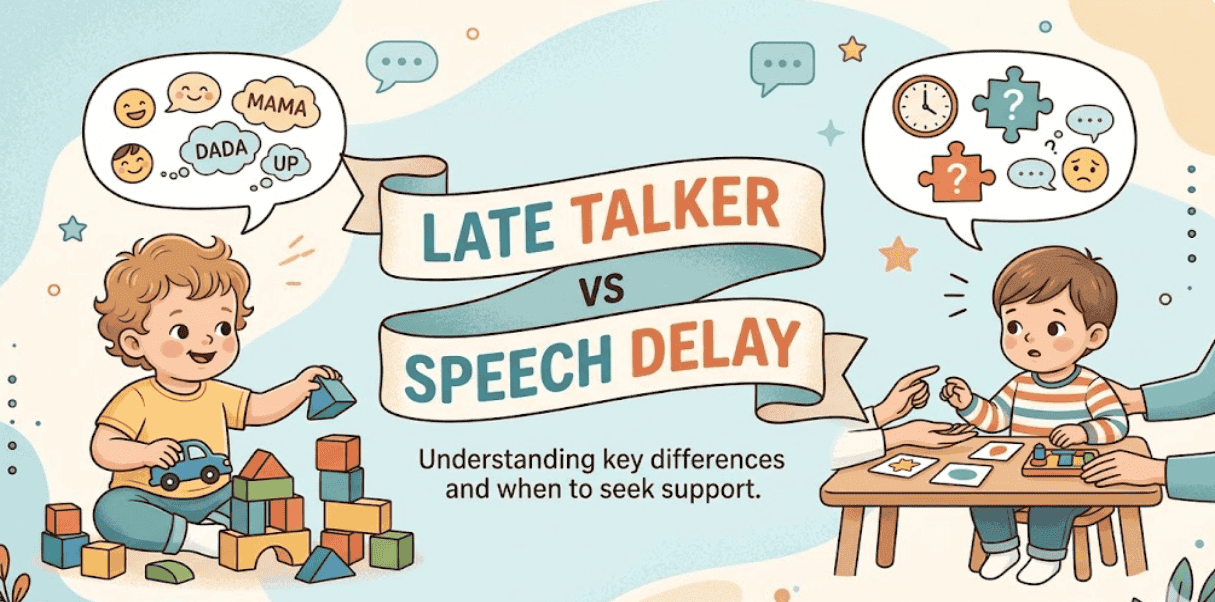
The terms “late talker” and “speech delay” are used interchangeably all the time — by parents, by grandparents, sometimes even by well-meaning family doctors. But according to a speech-language therapist , these two things are distinct, and understanding the difference could genuinely shape how you support your child.
A late talker is a toddler — usually between 18 and 30 months — who has fewer words than expected for their age but is developing normally in every other area. They understand what you say to them. They make eye contact. They play with toys the right way. They’re curious and socially connected. They just haven’t started talking much yet.
A speech or language delay, on the other hand, often goes beyond vocabulary. It may involve difficulty understanding language (not just producing it), trouble forming sounds correctly, challenges with sentence structure, or delays that show up alongside other developmental concerns like limited social engagement or difficulty following simple instructions.
The key difference comes down to one word: profile. A late talker has one gap in an otherwise typical developmental picture. A child with a speech delay often shows a broader pattern — and that pattern usually calls for professional evaluation and support.
What “Normal” Actually Looks Like
Before you start comparing your child to every toddler at the playground, it helps to know what developmental research actually says about language timelines.
- By 12 months: Most children say 1–3 words and understand simple commands like “no” or “come here.”
- By 18 months: A typical toddler uses around 10–20 words and points to things they want.
- By 24 months: Children generally have a vocabulary of 50+ words and are beginning to combine two words together, like “more milk” or “daddy go.”
- By 36 months: Most three-year-olds speak in short sentences and can be understood by strangers most of the time.
These are general windows, not finish lines. There’s real variation within typical development. But if your child is significantly behind these markers — especially in multiple areas — that’s worth paying attention to.
The Late Talker: Wait and Watch, or Act?
Research suggests that around 10–15% of toddlers are late talkers. Of those, a meaningful portion — sometimes called “late bloomers” — do catch up to their peers without any formal intervention. By the time they enter kindergarten, many are right on track.
That sounds reassuring. And it is — to a point.
The difficulty is that there’s no reliable way for a parent to know in advance whether their child is a late bloomer or whether the delay signals something that needs support. That uncertainty is precisely why many specialists recommend not simply waiting. Early intervention — if it turns out to be needed — is consistently more effective than delayed intervention. Language skills build on themselves, and the brain is most receptive to language learning in the first three years of life.
So the guidance from most child development professionals isn’t “panic” or “do nothing.” It’s “get a professional opinion sooner rather than later.” A speech-language pathologist can assess your child’s full communication profile and give you a clear picture, which is far more valuable than any checklist online.
Signs That Go Beyond “Late Talking”
While every child’s journey is different, there are certain signs that suggest something more than late talking may be going on. These aren’t reasons to spiral — they’re reasons to reach out to a professional.
Consider scheduling an evaluation if your child:
- Does not respond to their name consistently by 12 months
- Shows little interest in communicating — not pointing, waving, or gesturing by 12–14 months
- Has lost words or skills they previously had at any age
- Rarely makes eye contact or seems disengaged from people around them
- Doesn’t seem to understand simple instructions by 18 months
- Has fewer than 50 words by age 2, or isn’t combining words at all
- Is difficult to understand even by family members by age 3
Any one of these, in context, might not mean much on its own. But taken together, or alongside your gut feeling as a parent, they’re worth discussing with your pediatrician or a speech therapist.
What Happens During a Speech Evaluation?
A lot of parents put off seeking help because they’re unsure what an evaluation actually involves — or they worry it will be stressful for their child. In reality, speech assessments for young children are usually play-based and child-friendly.
A speech-language pathologist will observe how your child communicates, both in structured activities and in natural interaction. They’ll assess receptive language (what your child understands), expressive language (what they can say), and sometimes speech clarity and oral motor function. The goal isn’t to label your child — it’s to understand them fully so that any support can be targeted and effective.
If therapy is recommended, early intervention programs exist in most countries, and many are available at low or no cost for children under age five.
What You Can Do at Home Right Now
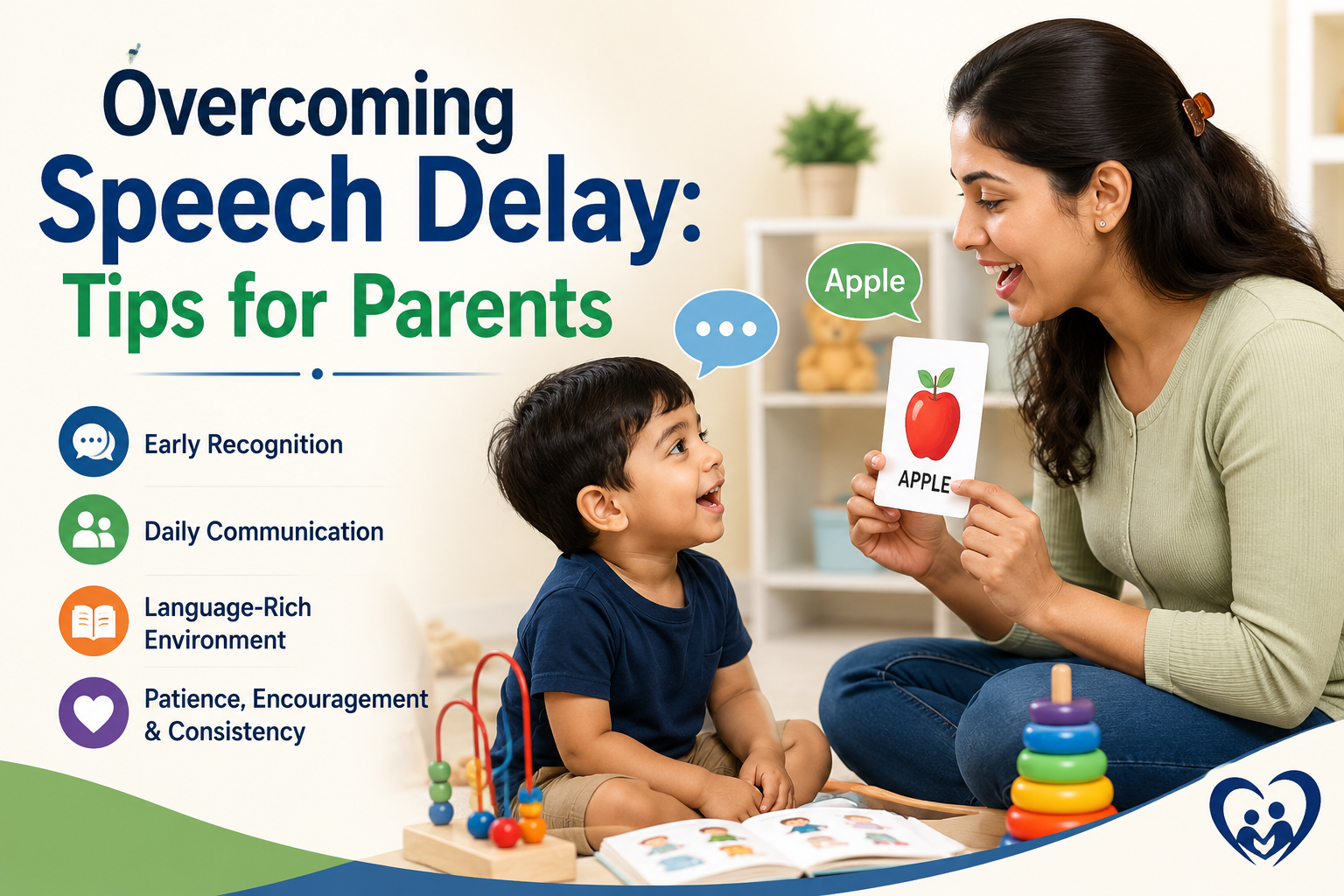
Whether your child is a late talker, has a diagnosed delay, or you’re simply not sure yet, there are evidence-backed ways to support language development every single day — no special equipment required.
Talk constantly. Narrate your day. “Now we’re washing your hands. The water is warm.” Children absorb language even before they produce it.
Read together daily. Even if your child can’t follow a full story, pointing at pictures and naming things builds vocabulary in powerful ways.
Respond to all communication. If your child points, acknowledge it. If they babble, respond as though they said something real. You’re teaching them that communication works.
Reduce screen time. Passive screen watching doesn’t develop language the way live interaction does. Real back-and-forth conversation is what the brain needs.
Don’t pressure or correct constantly. Expand what they say instead. If they say “ball,” you say “Yes, the big red ball!” — this models language without discouraging them.
Frequently Asked Questions
At 24 months, most children have around 50 or more words and are starting to combine two words together. Fifteen words at this age is below the typical range. This doesn't mean something is definitely wrong, but it does mean it's worth having a speech-language pathologist take a look. Early evaluation is always better than waiting and wondering.
Bilingual children sometimes have smaller vocabularies in each individual language, but their total word count across both languages is usually on par with monolingual peers. Bilingualism does not cause speech delays. If your bilingual child seems to be falling behind in both languages — not just one — that's worth evaluating.
A speech delay affects how clearly a child produces sounds and words — it's about pronunciation and articulation. A language delay is broader and involves difficulties understanding or using language meaningfully, including vocabulary, sentence structure, and communication intent. A child can have one, the other, or both.
It is never too late to benefit from speech and language therapy. That said, the earlier support begins, the greater the impact — especially for children under five, whose brains are in a critical window for language development. Even older children, teens, and adults see meaningful progress with the right support.
You know your child better than anyone. If you feel your concerns aren't being taken seriously, it's completely appropriate to ask for a referral to a speech-language pathologist directly, or to seek one out independently. You don't need to wait for someone else to validate your instincts. Trust them.